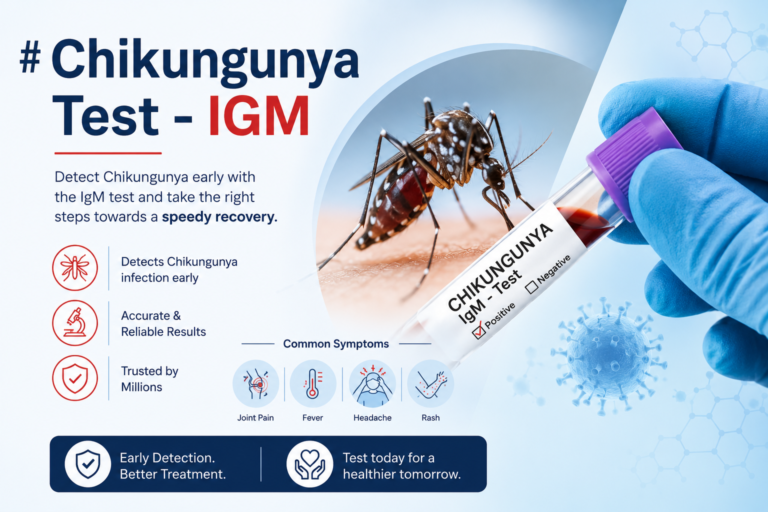
Chikungunya is a mosquito-borne viral infection that causes sudden fever and severe joint pain, along with symptoms such as headache, muscle pain, joint swelling, and rash. As some of these symptoms overlap with other infections, a Chikungunya IgM test is required to confirm the diagnosis. That’s where we step in. With NABL-accredited laboratories, affordable testing, and convenient home sample collection, Thyrocare makes virus testing simple, accessible, and convenient. Thyrocare’s Chikungunya IgM test uses the ELISA method to detect IgM antibodies produced in response to the chikungunya virus. Reports are available on time, helping you access your results conveniently and discuss the next steps with your doctor.
What is a Chikungunya IgM Test?
A Chikungunya IgM Test is a blood test used to detect Immunoglobulin M (IgM) antibodies against the chikungunya virus. IgM antibodies are produced by the body’s immune system following infection and can provide evidence of a recent chikungunya infection.
The chikungunya IgM antibody test is performed on a blood sample and commonly uses an enzyme-linked immunosorbent assay, or ELISA, to detect these antibodies.
Unlike tests that look directly for viral genetic material, a chikungunya ELISA test identifies the immune response generated against the infection. Chikungunya-specific antibodies generally become detectable during the first week after the onset of illness, making the timing of testing important.
What Does the Chikungunya IgM Test Detect?
The Chikungunya IgM Test detects IgM antibodies produced by the immune system in response to the chikungunya virus. The test does not directly detect the virus itself.
The presence of these antibodies can support chikungunya virus diagnosis, particularly when the result is interpreted alongside:
- The symptoms you are experiencing
- The number of days since the symptoms started
- Recent mosquito exposure
- Travel to or residence in an area where chikungunya is circulating
- Your doctor’s clinical assessment
As with any laboratory test for chikungunya, the result should not be interpreted in isolation. A healthcare professional can consider your test result alongside your medical history and symptoms to determine whether further evaluation is necessary.
When Should You Get a Chikungunya IgM Test?
The timing of a chikungunya diagnostic test is important because different tests may be useful at different stages of infection.
Chikungunya virus disease can be diagnosed using nucleic acid testing during the acute phase or serological testing after the first week of illness. Chikungunya-specific antibody levels are typically detectable by around the first week after symptoms begin.
A doctor may advise a chikungunya fever test if you develop symptoms such as:
- Sudden fever
- Significant joint pain or stiffness
- Joint swelling
- Skin rash
- Headache
- Muscle pain
Testing may also be considered if you have recently been exposed to mosquitoes or have travelled to or stayed in an area where chikungunya transmission is occurring.
Testing very early in the illness may not detect IgM antibodies because the body may not yet have produced them at detectable levels. Your doctor may advise an alternative test or repeat testing depending on when your symptoms began.
Who May Need a Chikungunya IgM Test?
A chikungunya lab test may be recommended for people who have symptoms suggestive of chikungunya, particularly fever accompanied by pronounced joint pain.
Testing may be considered for:
- People experiencing symptoms such as fever, joint pain, joint swelling, or rash
- Individuals who live in or have recently travelled to an area where chikungunya transmission is occurring
- People who have had significant mosquito exposure and subsequently develop symptoms
- Patients whose symptoms may overlap with other mosquito-borne illnesses such as dengue
- Anyone advised by a healthcare professional to undergo a chikungunya screening test
Symptoms alone cannot reliably distinguish chikungunya from every other febrile illness. Your healthcare provider may recommend appropriate laboratory investigations based on your symptoms and exposure history.
Chikungunya IgM ELISA Test vs PCR Test
Different blood tests for chikungunya virus detect different markers and may be useful at different stages of infection.
Chikungunya IgM ELISA Test
Thyrocare’s Chikungunya IgM ELISA Test detects IgM antibodies produced by the immune system against the virus. IgM testing becomes more useful towards the end of the first week of illness and thereafter.
Chikungunya PCR Test
A chikungunya PCR test, usually RT-PCR, detects the virus’s genetic material directly and is generally more useful during the acute phase, particularly within the first week of symptoms.
Chikungunya Rapid Test
A Chikungunya Rapid Test typically uses a rapid immunoassay to detect chikungunya antibodies and provides quicker screening than conventional laboratory ELISA. It is not the same as an ELISA test or PCR test. Rapid IgM tests are a recognised category of chikungunya serological tests, although performance can vary by assay.
The most suitable chikungunya diagnostic test depends on how long symptoms have been present and your doctor’s assessment. Thyrocare offers Chikungunya IgM and rapid testing options, making it convenient to access the test recommended for you.
Explore Other Fever Testing Options with Thyrocare
Thyrocare also offers individual tests such as the dengue test and typhoid test, allowing patients to choose specific investigations based on their doctor’s advice. For broader fever evaluation, the Jaanch Monsoon Fever Panel in multiple variants (Mini, Basic, Advanced and Rapid formats) includes parameters curated to assess infections such as malaria, typhoid, dengue, chikungunya and more.
This gives patients the flexibility to book either an individual test or a broader fever panel, depending on their symptoms and clinical recommendation.
Chikungunya IgM Test Preparation
The Chikungunya IgM Test generally does not require extensive preparation.
- Fasting: Fasting is generally not required for an antibody blood test unless you are undergoing other investigations at the same time that require fasting.
- Water: You can usually drink water as normal before providing the sample.
- Medicines: Inform your doctor or sample collection professional about any medicines or supplements you are taking.
- Regular medication: Do not stop prescribed medicines unless your doctor specifically advises you to do so.
If the chikungunya blood test is booked along with other investigations or as part of a health package, check whether those tests have separate preparation requirements.
How is the Chikungunya IgM Test Done?
Thyrocare makes the Chikungunya IgM Test straightforward with trained sample collection professionals and home collection across serviceable locations.
A small blood sample is collected from a vein in your arm using a sterile needle and transferred to a sample tube. The sample is then sent to a Thyrocare laboratory, where it is processed using ELISA methodology to detect chikungunya-specific IgM antibodies. The collection itself usually takes only a few minutes, although mild temporary discomfort or bruising may occur at the needle site.
Chikungunya IgM Test Results: What Do They Mean?
Your chikungunya test report indicates whether chikungunya-specific IgM antibodies were detected in your blood. The exact reporting format and cut-offs depend on the assay used by the laboratory.
Chikungunya IgM Positive
A chikungunya IgM positive or reactive result means that chikungunya-specific IgM antibodies have been detected above the assay’s defined cut-off. This may indicate a recent chikungunya virus infection.
However, IgM results should be interpreted together with your symptoms, exposure history, and the timing of sample collection. False-positive IgM results can occur, and additional testing may sometimes be considered depending on the clinical circumstances.
Chikungunya IgM Negative
A negative or non-reactive result means chikungunya-specific IgM antibodies were not detected above the laboratory’s cut-off.
A negative result does not always exclude infection if the chikungunya fever test was performed very early, before sufficient antibodies had developed. If chikungunya is still strongly suspected, your doctor may advise repeat testing or another diagnostic method depending on the stage of illness.
Equivocal or Borderline Result
If your chikungunya blood report is reported as equivocal or borderline, the antibody level has not clearly fallen within the laboratory’s positive or negative category.
Your doctor may recommend repeating the test after an appropriate interval or considering another test depending on your symptoms and the timing of the illness.
Always refer to the reference values printed on your chikungunya test report, as laboratories and assays may use different cut-offs.
It is also important not to confuse the laboratory reference range with a chikungunya fever range. There is no particular body temperature that can confirm chikungunya on its own. Fever is a common symptom, but laboratory testing and clinical evaluation are needed to establish the cause.
Factors That Affect Chikungunya Test Price
The chikungunya test price may vary depending on your location, applicable offers or discounts, and whether the test is booked individually or as part of a fever-testing package or panel. Thyrocare offers affordable testing options to help make fever-related diagnostics more accessible.
To check the current Chikungunya IgM Test price, enter your city or PIN code on the Thyrocare website and review the latest test details before booking. You can also enquire about the current price through the Thyrocare app, WhatsApp, or phone booking service.
Why Choose Thyrocare for Your Chikungunya IgM Test?
Choosing the right diagnostic provider can make your Chikungunya IgM Test more convenient, reliable, and easier to manage. As one of the best pathology labs in India, Thyrocare combines an accredited laboratory network, trained sample collection professionals, digital reporting, and multiple booking options to make chikungunya blood testing accessible and straightforward.
- Testing is supported by Thyrocare’s NABL- and ISO-accredited laboratory network.
- Thyrocare offers more than 1,300 tests and profiles, including individual investigations such as the Typhoid test and Widal test, and broader fever-related testing options.
- Trained sample collection professionals provide home sample collection across serviceable locations while following defined collection protocols.
- Laboratory quality control is supported by qualified MD pathologists, cold-chain processes, and rechecking of abnormal results.
- Reports are shared digitally through WhatsApp, SMS, and email, making it easy to access your Chikungunya Test report once it is ready.
- You can book the chikungunya lab test through the Thyrocare website, app, WhatsApp, phone, or callback request.
- Thyrocare offers convenient testing options at affordable rates, helping patients access a laboratory test for chikungunya without unnecessary inconvenience.
Book a Chikungunya IgM Test Online with Thyrocare
Thyrocare offers several convenient ways to book a Chikungunya IgM Test online or offline, allowing you to choose the option that best suits you. You can schedule the test through the website, app, WhatsApp, phone, or callback request.
Through the Thyrocare Website
To book a Chikungunya IgM Test online, click ‘Book’ on the Thyrocare Chikungunya IgM Test page, review the test details, and select ‘Proceed’. Enter your mobile number, verify it using an OTP, add the patient and collection details, choose an available home collection slot, and complete the booking.
Through the Thyrocare App
Open the Thyrocare app, search for the Chikungunya IgM Test and follow the instructions to select the patient, address and preferred collection slot.
Through WhatsApp
To book a Chikungunya IgM Test through WhatsApp, send your test request to Thyrocare on 98706-66333.
By Phone
Call Thyrocare on 022-309-0000 to book the Chikungunya IgM Test by phone. A representative can help you check test details, current pricing and applicable discounts, provide the required information, and schedule home sample collection in your location.
Request a Callback
Enter your mobile number in the callback form, verify it through OTP, and submit the request. A Thyrocare representative can then assist you with the booking.
After booking, Thyrocare shares a tracking link that allows you to check the technician’s status, monitor sample collection, and download the Chikungunya Test report once it is ready. Keep the booking confirmation and tracking link securely available until the report is issued so that you can conveniently follow collection updates and access your final digital report.
If you have symptoms suggestive of chikungunya or your doctor has advised testing, Thyrocare offers a reliable and convenient way to book a Chikungunya IgM Test. Check the test details and book your test today.
Frequently Asked Questions
How long does Chikungunya last?
The fever and other acute symptoms of chikungunya usually improve within a few days to a week. Joint pain, however, may continue for several weeks or months in some people.
Can chikungunya be detected by a CBC?
No. A CBC may show changes in blood cell counts, but it cannot confirm chikungunya. A specific chikungunya blood test, such as an IgM antibody test or PCR, is required for diagnosis.
What is the CRP level in chikungunya?
There is no specific CRP level that confirms chikungunya. CRP is a general marker of inflammation and should not be used as a standalone chikungunya diagnostic test.
Which Chikungunya Test is recommended for early diagnosis?
A chikungunya PCR test may be useful during the early phase of infection, while a Chikungunya IgM Test is generally more useful after antibodies develop. Your doctor can recommend the right test based on symptom duration.
What should I do if my Chikungunya test results are positive?
If your Chikungunya Test report is positive, consult a doctor for interpretation and further guidance. Do not start or stop medicines based only on the test result.
How long does it take to receive the Chikungunya Test report?
Once your sample reaches the Thyrocare laboratory, reports are released within an average turnaround time of approximately 3.3 hours, although some tests may take longer to ensure accuracy. You will receive the digital report through a link shared via your registered email, SMS, or WhatsApp.
Can dengue and chikungunya be tested together?
Yes. If symptoms overlap, a doctor may recommend a dengue IgM test along with a chikungunya test to help identify the cause of fever.
Can I take my regular medicine before the test?
Regular medicines generally do not need to be stopped before a Chikungunya IgM Test. However, inform your doctor or sample collection professional about any medicines or supplements you are taking.
How does Thyrocare ensure accurate lab test results?
Thyrocare supports testing through its NABL- and ISO-accredited laboratory network, with qualified MD pathologists, defined sample-handling processes, cold-chain protocols and rechecking of abnormal results.
Does Thyrocare provide home sample collection for the Chikungunya Test?
Yes. Thyrocare offers home sample collection for the Chikungunya IgM Test across serviceable locations. Enter your PIN code while booking to check whether home collection is available in your area, then select a suitable slot through the website, app, WhatsApp, or phone.