Key Takeaways
|
A high or low ESR result can be worrying, especially when you are not sure what the number means. The erythrocyte sedimentation rate test, or ESR test, is commonly used to look for signs of inflammation, but a single value alone cannot diagnose a specific condition. What matters is how your ESR level compares with the expected range and how it fits with your symptoms, age, medical history and other test findings. This article explains what normal, high and low ESR levels can indicate and how to interpret your ESR test results.
What is an ESR Test and What Does It Measure?
For anyone wondering what an ESR test is and why it may be recommended, ESR is essentially an indirect measure of inflammatory activity.
A blood sample is placed in a tall, thin tube, and the laboratory records how far the red blood cells fall in one hour. The ESR test results are generally reported in millimetres per hour (mm/hr). The farther the cells fall during that period, the higher the sedimentation rate.
Inflammation can increase ESR because it can cause red blood cells to stick together. These clusters are heavier than individual cells and therefore settle faster. A raised result can indicate that inflammation is occurring somewhere in the body, but it cannot identify its location or cause on its own.
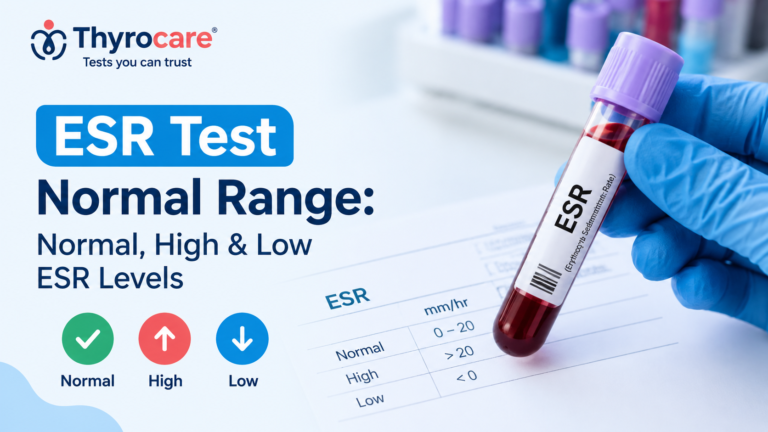
What is the Normal ESR Range?
There is no single ESR normal range that applies equally to everyone. Age and sex can influence results, while individual laboratories may also use slightly different reference values or testing methods.
For adults tested using the commonly used Westergren method, reference values often cited are:
| Group | Typical ESR Reference Value |
| Newborn babies | 0–2 mm/hr |
| Children upto puberty | 3–13 mm/hr |
| Men below 50 years | Less than 15 mm/hr |
| Men above 50 years | Less than 20 mm/hr |
| Women below 50 years | Less than 20 mm/hr |
| Women above 50 years | Less than 30 mm/hr |
These figures provide general context rather than a universal definition of the normal ESR range. Your laboratory report should contain the reference interval used for your test, and that range should be considered when interpreting the result.
The erythrocyte sedimentation rate normal range may also differ in children. This is one reason an ESR value should not be compared with another person’s result without considering age and clinical circumstances.
What Can High ESR Levels Indicate?
High ESR levels mean the red blood cells have settled faster than expected. As a general example, an ESR of around 40–60 mm/hr may be considered clearly elevated in many adults, while values above 100 mm/hr are often regarded as markedly high. However, the significance of the number depends on age, sex, laboratory reference range and clinical context. A raised ESR can occur for many reasons, so it should be viewed as a signal that may require further interpretation rather than as a diagnosis.
Infection
Some infections can trigger an inflammatory response that raises the ESR. Examples include tuberculosis, pneumonia, endocarditis, osteomyelitis, and certain severe bacterial infections. However, the ESR value cannot tell whether an infection is present or identify the organism responsible.
Autoimmune and Inflammatory Conditions
ESR testing may also be used when doctors are investigating or monitoring inflammatory and autoimmune disorders. Raised values can occur in conditions such as rheumatoid arthritis, polymyalgia rheumatica, giant cell arteritis and some forms of vasculitis.
In people already diagnosed with an inflammatory condition, changes in ESR may sometimes contribute to monitoring disease activity or response to treatment.
Anaemia and Other Blood-Related Factors
Anaemia can influence the rate at which red blood cells settle and may contribute to an elevated ESR. Other characteristics of the blood and red cells can also affect the result, which is another reason the number should not be interpreted independently.
Other Possible Causes
An increased ESR may also be associated with factors or conditions including:
- Kidney disease
- Pregnancy
- Increasing age
- Certain cancers
- Some thyroid conditions
Does a Higher ESR Always Mean a More Serious Condition?
No. A higher result does not automatically mean that a condition is more severe.
The ESR test’s meaning depends heavily on the clinical situation. The same ESR value can have different significance in two people depending on their age, symptoms, medical history and other laboratory findings.
A markedly raised ESR may encourage a doctor to investigate further, but even a very high result does not identify the underlying cause by itself. Conversely, inflammation can sometimes be present despite a normal ESR.
When ESR is being used to monitor an existing condition, the pattern over several tests may sometimes provide more useful information than one isolated measurement.
What Can Low ESR Levels Indicate?
Low ESR levels mean the red blood cells are settling more slowly than expected. Unlike an elevated result, a low ESR is often not a cause for concern by itself.
Lower-than-expected results can sometimes be associated with conditions that alter the number or characteristics of blood cells. These may include:
- A high red blood cell count, such as polycythaemia
- Certain red blood cell disorders
- Reduced fibrinogen levels
- Very high white blood cell counts
- Certain liver, kidney or blood-related conditions
A low reading should therefore be interpreted according to the reason the test was ordered and any other abnormalities present.
What Can Affect ESR Test Results Apart From Disease?
An abnormal ESR blood test does not necessarily mean that a new medical condition is present. Several physiological and other factors can affect how quickly red blood cells settle.
These include:
- Age
- Pregnancy
- Menstrual cycle
- Anaemia
- Red blood cell size and shape
- Certain medicines or supplements
- Other existing health conditions
Ageing, pregnancy and anaemia, for example, can influence ESR readings. Medications and supplements may also affect results, so it is helpful to tell your doctor about anything you are taking when discussing your report.
ESR Test Results: Why One Number Is Not Enough
An ESR value is only one piece of clinical information.
When reviewing ESR test results, a doctor may consider your symptoms, medical history and physical examination findings along with other laboratory investigations. Tests such as a complete blood count and C-reactive protein may sometimes provide additional information.
For example, an elevated ESR in someone experiencing persistent joint pain may be interpreted differently from the same result in someone pregnant or recovering from an infection.
This context is important because ESR is a non-specific inflammatory marker. It can suggest that something may require attention, but it does not explain precisely what is happening.
Get Your ESR Levels Checked with Thyrocare
For a test that may guide the next step in your care, choosing a trusted diagnostic provider matters. Thyrocare combines affordable testing with quality-focused processes, including its NABL- and ISO-accredited laboratory network, qualified MD pathologists, defined cold-chain protocols and rechecking of abnormal results. Home sample collection is available across serviceable locations, while digital reports can be accessed through WhatsApp, SMS and email for added convenience. With booking available through the website, app, WhatsApp and phone, getting tested is simple and accessible. Book your ESR test with Thyrocare today for reliable, quality-led testing at an affordable price. Connect with us on WhatsApp at 9870666333 (24×7), call us at 022-30900000, or email customersupport@thyrocare.com. Our experts will be happy to guide you.
Frequently Asked Questions
What happens during an ESR test?
An ESR blood test requires a small blood sample, usually taken from a vein in your arm. The sample is then analysed in the laboratory to measure how quickly the red blood cells settle in a test tube over one hour. The result is generally reported in mm/hr.
Do I need to fast before an ESR test?
An ESR test usually does not require fasting. However, if your doctor has advised other blood tests at the same time, you may need to follow specific preparation instructions for those investigations.
Can ESR be high even if I feel healthy?
Yes. Factors such as age, pregnancy, and certain underlying conditions can affect ESR even when obvious symptoms are absent. An unexpected high result should be interpreted alongside your medical history and other findings rather than in isolation.
Can an infection cause high ESR levels?
Yes. Infections can trigger inflammation and may raise ESR. However, a high ESR cannot confirm that an infection is present or identify which infection may be responsible.
Can ESR be normal even when inflammation is present?
Yes. A result within the normal ESR range does not completely rule out an inflammatory condition. Doctors consider symptoms and other tests when deciding whether further evaluation is required.
Why might ESR remain high after an illness improves?
ESR can take time to return towards its usual level because it is influenced by changes in blood proteins and red blood cell behaviour. Your doctor may consider the result alongside your recovery and other test findings.
Is a low ESR level something to worry about?
Usually, a low ESR by itself is not a cause for concern. However, unusually low ESR levels can sometimes occur with certain blood-related conditions, so the result should still be considered within the wider clinical picture.
How soon will I get my ESR test report from Thyrocare?
Once your sample reaches the laboratory, Thyrocare typically releases reports within an average turnaround time of around 3.3 hours. Some tests may take longer depending on the processing requirements. When your report is ready, you will receive a link through your registered email, SMS or WhatsApp. If you have chosen a hard copy at an additional cost, it is usually dispatched after report generation and delivered within 3–5 days, along with tracking details.